Showing posts with label tourism. Show all posts

Tuesday, October 16, 2007

Maradonian Nativity. God is Argentine


Maradonian nativity. God is argentine

Argentina and specially Buenos Aires by these days start to pay homage to his best hero "Diego Maradona"
The Nativity of the Maradonian Church, has been commemorated since October 30th 1998 since it is Diego Armando Maradona birthday . A group of friends started this church in the city of Rosario (Santa Fe) and the number of rites and followers/members has increased since then.
The first “Maradonian Easter” was celebrated on June 22nd 2002 and it coincides with the goal scored by Maradona to the British National Team, better known as “The hand of God” and it is repeated year after year. Even the Ten Commandments and different prayers were re-versioned

There you can see the members/followers and join the cult.


La Navidad maradoniana. Dios es argentino

Argentina y especialmente Buenos Aires rinde homenaje por estos días a su máximo ídolo "Diego Maradona".
Desde el 30 de Octubre de 1998 se conmemora esa fecha la Navidad de la Iglesia Maradoniana, dado que es cuando se rememora el nacimiento de Diego Armando Maradona . En esa fecha un grupo de amigos comenzó en la ciudad de Rosario (Santa Fe), acrecentando su números de ritos y de fieles/socios.
El 22 d junio de 2002 celebraron las primeras “pascuas maradonianas”, coincidiendo con el gol a los ingleses, más conocido como “la mano de Dios”, hasta hoy repitiéndose a cada año. Incluso reversionaron los 10 mandamientos y diversas plegarias.

Allí mismo uno puede, ver los socios/fieles famosos y adherirse al culto.


Thursday, September 27, 2007

Flashmob: First Reverse Marathon in BA


Flashmob: First Reverse Marathon

The First Reverse Marathon in history took place at Parque Centenario in the City of Buenos Aires on September 8th.
This flashmob was the opening event for the IX Fuga Jurásica Multimedia Experimental Art Festival , that has taken place in the Museum of Natural Sciences Bernardino Rivadavia of the City of Buenos Aires since 1998.
The idea is to make a Reverse Marathon that is related to the integral concept of this festival: “Experiencing is good”, which was created and developed by Underground School of Creatives, who are responsible for the integral communication of the event.
In order to run in reverse, there were persons who managed to fit improvised rear-view mirrors that consisted of Cds attached to their caps. Talking about mirrors, the numbers on the sweatshirts were printed on the wrong side.
Here is the link to the article in La Nación Newspaper.


Flashmob: Primer Maratón marcha atrás

El sábado 8 de septiembre se disputó la Primera Maratón Marcha Atrás de la historia , en el Parque Centenario de la Ciudad de Buenos Aires.
Este flashmob fue el evento de apertura del IX Festival de Arte Multimedia Experimental Fuga Jurásica , que desde 1998 se viene realizando en el Museo de Ciencias Naturales Bernardino Rivadavia de la Ciudad de Buenos Aires.
La idea de hacer una Maratón Marcha Atrás responde al concepto integral de este Festival: “Experimentar es bueno”, creado y desarrollado por Underground Escuela de Creativos, responsable de la comunicación integral del evento. Para correr mejor en reversa, hubo quienes se las ingeniaron en armar improvisados espejos retrovisores con Cds adosados a sus caps. Hablando de espejos: Los números en las sudaderas estaban impresos al revés.
Aquí el link a la nota en el diario La Nación.


Monday, August 20, 2007

Urban Art (Photos)


The streets of Buenos Aires hide different corners from art. The art of urban sketchers, graffitti tribes and filete sketchers abound by all the corners.
Here a selection of photos of urban art in different parts of the city.


Las calles de Buenos Aires ocultan diversas esquinas de arte. El arte de dibujantes urbanos, graffiteros y fileteadores, abunda por todas las esquinas.
Aquí una selección de fotos del arte urbano en diversas partes de la ciudad.

Monday, August 06, 2007

Elvis in Buenos Aires

The rumour of the moment: Does Elvis live in Argentina?

The city is full of this kind of stories, but these days Buenos Aires have a lot of papers searching Elvis Presley. In 1984, after eight years of a dark military dictatorship, democracy was beginning to come true in Argentina. Several hidden stories came to light together with the signs of freedom. Of course that the issue of the disappeared was the most transcendent and revealing story of them all. Nevertheless, other stories that were not so important were spread by means of several contracts, deals and agreements that were made by the hierarchs of the dictatorship with the different related governments and important people who were functional to their intentions. Elvis “The King” was the center of attraction of one of those stories. Although it seems unbelievable, Elvis came to Argentina the day after his fictitious death. While the public display of pain because of the death of the idol was happening in front of his mansion in Graceland, Memphis, a 42-year-old fat guy was starting a new life at 15,000 km south from his hometown. After ten years of a thorough research, more than 150 interviews, more than 230 decoded reports, and hundreds of graphic and oral reports certify the present report that shows the presence of Elvis in Argentina.” Taking into account this, Jerónimo Burgués, an Argentine writer who is living in the province of San Luis confirms by means of his book “The king is living among us” that the death of Elvis is part of a political agreement between the FBI, the CIA and the Argentine Federal Police. Burgues confirms that “The King” has lived in the Province of Córdoba and that he has bought parcels in the Patagonia and that he has lived undercover in this country for almost 30 years. The myth confirms that the musician has collaborated with the United States of America government in denouncing the mafia in exchange for a new and confidential identity. Is just a fake or its real? Who knows


El rumor del momento. Elvis vive en Argentina?

La ciudad está llena de este tipo de historias, pero por estos días esta llena de papeles que buscan a Elvis Presley en la Argentina. “En 1984, luego de 8 años de oscura dictadura militar, la democracia empezaba a ser una realidad en la Argentina. Junto con los primeros e incipientes signos de libertad, comenzaron a salir a flote muchas historias ocultas durante esos años. Desde luego que la cuestión de los desaparecidos fue la más trascendente y relevante de todas. Sin embargo, y paralelamente, otras historias menos importantes empezaron a circular, dando cuenta de distintos contratos, negociados y acuerdos llevados a cabo por los jerarcas del Proceso, con los distintos gobiernos y personalidades afines, y funcionales a sus propósitos. Una de esas historias tuvo como protagonista a "El Rey", Elvis Presley . Porque aunque parezca increíble, Elvis Presley llegó a la Argentina al día siguiente de su ficticia muerte. Mientras las demostraciones de dolor por la muerte del ídolo se sucedían frente a su mansión Graceland, en Memphis, un obeso de 42 años comenzaba una vida completamente nueva a más de 15.000 kilómetros al sur. Más de 10 años de exhaustiva investigación, más de 150 entrevistas, más de 230 informes decodificados y cientos de testimonios gráficos y orales avalan el presente informe demostrando la presencia de Elvis en Argentina.” Con este preludio Jerónimo Burgués, un escritor argentino radicado en la Provincia de San Luis, Argentina, sostiene mediante el libro "El rey vive entre nosotros" que la muerte de Elvis es parte de un entramado político entre el FBI, la CIA y la Policía Federeal Argentina. Burgués sostiene que "El Rey" ha vivido en la Provincia de Córdoba, compró tierras en la Patagonia y mantuvo una estadía incógnita en el país por casi 30 años. El mito sostiene que el músico habría colaborado con el gobierno de Estados Unidos denunciando a la mafia, a cambio de una nueva identidad reservada. Nadie sabe la veracidad de este rumor, pero puede ser posible.


LINK Elreyentrenosotros.com.ar

Monday, July 23, 2007

La Bicicleta Naranja


Another way to visit Buenos Aires

The transit is growing day by day in the city because the companies sell a lot of cars, so the solution doesn't seem to be clear. A group of touristic guides taking that into account and found La Bicicleta Naranja, an interesting solution to avoid the problem. La Bicicleta Naranja is something more than a route in the map, is another way to know Buenos Aires. The service is simple. People could rent an orange bike with a normal or thematic tour like South , North , River coast or Ecological reserve. An alternative way to travel around Buenos Aires for tourists and Porteños too.


Una nueva manera de visitar Buenos Aires

El tránsito está creciendo día a día en la ciudad y la solución no parece estar clara debido al crecimiento constante del parque automotor. Un grupo de guías turísticos tomando eso en consideración y encontraron en La Bicicleta Naranja, una solución interesante para evitar el problema. La Bicicleta Naranja es algo más que una ruta en el mapa, es otra manera de conocer Buenos Aires. El servicio es simple;Se puede alquilar una bici anaranjada con un viaje normal o temático como el sur de la ciudad, el norte, la costa del río o la reserva ecológica. Una manera alternativa de viajar alrededor de Buenos Aires para los turistas y también para los Porteños.


Saturday, June 16, 2007

Concept cars


Claromachines: New concept cars

In the seaside city of Claromecó, Province of Buenos Aires, Argentina, certain beach concept cars have been designed in a handmade way.
The most outstanding peculiarity is that the bodies of these cars have been taken off due to the high levels of saltpeter that corrode and rust the bodies of the cars very quickly. In this way, the inhabitants of Claromecó can enjoy their vehicles and show off in the beaches, dunes, and other attractions of the coast of this beautiful seaside city.

More information at claromachines


Claromachines: Nuevos concept car En la ciudad balnearia de Claromecó, Provincia de Buenos Aires, Argentina, desde hace varios años se vienen fabricando artesanalmente ciertos concept cars playeros.
La particularidad más sobresaliente es que a estos autos se les ha quitado la carrocería, debido a que el los elevados niveles de salitre que se encuentran en el aire corroen y oxidan rápidamente las carrocerías. De esta manera los habitantes de Claromecó pueden disfrutar de sus vehículos y pasear por las playas, las dunas y demás atracciones del litoral marítimo de esta bella ciudad balnearia.

Más información claromachines


Sunday, June 10, 2007

"Las 44 cuadras de Jorge Kern"

"Jorge Kern's 44 blocks"

The Fiap (Festival Iberoamericano de Publicidad) was made last month, and the commercial "Las 44 cuadras de Jorge kern" ( Jorge Kern's 44 blocks), made by the agency Madre Buenos Aires for Banco Hipotecario were the only Grand Prix in the television category. The campaign “Dueños” (owners) inspired by 80's heightens the liberties to a person when has a real estate, and in that moment stop to being a renter.
The commercial has a clear inspiration made by 1983's short film “The Crimson Permanent Assurance”, including in the film "The Meaning of Life" directed by Terry Gilliam. The music in the commercial is a cumbia band cover called “Clasiqueros” which played world wide classics , in this case “Last Train to London” of Electric Light Orchestra.


"Las 44 cuadras de Jorge Kern"

A un mes de realizado el Fiap (Festival Iberoamericano de Publicidad), el comercial "Las 44 cuadras de Jorge Kern", realizado por Madre Buenos Aires para el Banco Hipotecario fue el único Grand Prix de la categoría televisión. La campaña "Dueños" inspirada en los años 80's realza las libertades que tiene una persona al poseer una propiedad, y en este caso deja de ser inquilino.
El comercial posee una clara inspiración realizada por "The Crimson Permanent Assurance", cortometraje incluido en The Meaning of Life (El sentido de la vida)de 1983, dirigido por Terry Gilliam. La musicalización del comercial es producto de una banda de cumbia que versiona clásicos mundiales "Clasiqueros", en este caso "Last Train to London" de Electric Light Orchestra.

Inspirations / Inspiraciones


Wednesday, March 07, 2007

"Fin de zona urbana"

"Fin de Zona Urbana" Art + field

300 kilometers far away from Buenos Aires, the field and the city met in a bold project: to summon through art and the agriculture to rescue the best thing of diverse disciplines making a contact point between rural and urban activities. Artists, engineers, producers agronomists, psychologists, technicians next to field workers added their knowledge and work to the social development to tie the collective art together agriculture.
The project is called “Fin de Zona Urbana” and have 17 artists, between students and professors of the IUNA , that was enabled by professors of the Agronomy in the University of Buenos Aires (UBA). They received advising of the technicians in charge of seedtime, as well as the contributions for the tourist promotion of the town. ( La Niña, 9 de Julio, Provincia de Buenos Aires). This collective try to carry out 10 original designs on the field.
The project tries to observe the tensions and dialogues between art and field in a place, which it was an exclusive space of the cows in an area of 912 meters by 834. The drawings use like resource the diversity of cultures, and the possibilities of variations that offer the moments of sowing, fertilization and harvests.
At the moment the group is experiencing in “Proyecto Rebaño”. The entailment between the cowbell of ewes and the art.

For more information: (02317) 493013, info@lacatita.com.ar


"Fin de Zona Urbana" Arte + campo

A casi 300 kilómetros de Buenos Aires, el campo y la ciudad se reunieron en un proyecto osado: convocar a través del arte y el agro a rescatar lo mejor de diversas disciplinas para realizar un punto de encuentro entre actividades rurales y urbanas. Para ello, artistas, ingenieros, productores agrónomos, psicólogos, técnicos junto a peones de campo sumaron sus conocimientos y trabajo al emprendimiento social para vincular el arte colectivo junto la agricultura.
El proyecto se llama “Fin de Zona Urbana” y lo conforman 17 artistas, entre alumnos y profesores del IUNA, que fueron capacitados por profesores de la Facultad de Agronomía de la Universidad de Buenos Aires (UBA). Ellos recibieron asesoramiento de los técnicos encargados de la siembra, así como también los aportes para la promoción turística del pueblo de los vecinos de “La Niña”, (9 de julio, Provincia de Buenos Aires) para llevar a cabo 10 diseños originales.
Se trata de observar las tensiones y diálogos de lo que fue un espacio exclusivo de las vacas en un área de 912 metros por 834. Los dibujos utilizan como recurso la diversidad de cultivos, y las posibilidades de variaciones que ofrecen los momentos de siembra, fertilización y cosecha.
Actualmente el colectivo está experimentando en “Proyecto Rebaño”. La vinculación entre la esquila de ovejas y el arte.

Para más información: (02317) 493013, info@lacatita.com.ar

Friday, March 02, 2007

Home Buenos Aires Hotel

Home Buenos Aires hotel

Home Buenos Aires became the first hotel in fashionable Palermo Hollywood when it opened in December 2005 and installed a new wave in the neighborhood. "Trendy hotels in the old Palermo Viejo" (New design-conscious, Wi-Fi-outfitted boutique hotels).
Home Buenos Aires Hotel was born when Tom Rixton, (a dj and record producer who worked with many bands including Depeche Mode, Elastica, Simple Minds, Cornershop and Tom Vek) and his wife Patricia O'shea decided to live in Buenos Aires after they married. "It was a lack of suitable accomodation in Palermo Viejo, where everyone wanted to stay" say the couple. After they realized the niche they created HOME Buenos Aires, a brand new custom - build designed to provide the best facilities for all guests in the middle of Palermo with an airy, light with a play on interior and exterior spaces. Home have 17 bedroom deceivingly small from the outside with interconnecting spaces, using plenty of glass to make the natural light.
Home Buenos Aires may be intimate but it offers some big time treats such as a Spa offering aryuvedic treatments, a Resto - bar offering breakfast, lunch and evening tapas with wines, signature cocktails of the best bartender in BA ( "Bar & Drinks magazine Awards 2006" Best Bartender) Norman Barone. The bar overlooks the 300 m2 garden with a heated "infinity pool" and deck area for sunbathing and taste the frozen vodkas or the best drinks in town. The Tip: Barone's signature drink: Rosemary-and-sorrel vodka Martini)
Palermo Viejo is undoubtedly the creative heart and social pulse of Buenos Aires. It boasts the city's greatest concentration of hip bars and restaurants to cater the dynamic crowd of fashionist, interior, designers and media moguls who live, work and play in the area. Palermo it's a typical "barrio", with old style character and cobblestone, tree - lined streets. Within easy reach of the city centre and all its attractions, but far enough away from the fumes, noise and general mayhem so Home hotel is a good way to have fun and take pleasure in the city in a creative environment.

Address: Honduras 5860, Palermo Viejo

Ps: If you want to listen Tom Rixton's dj sets check it on March 8th in Niceto Club nearby his hotel.


Home Buenos Aires hotel

Home Buenos Aires se convirtió en el primer hotel "trendy" en Palermo Hollywood cuando abrió en diciembre de 2005. Muy pronto instaló una nueva tendencia en este barrio “Hoteles de diseño en Palermo Viejo”. -( Hoteles boutique de nuevo diseño y equipados con Wi-Fi).
Home Buenos Aires nace cuando Tom Rixton, (un dj productor musical que trabajó con muchas bandas incluyendo Depeche mode, Elastica, Simple Minds, Cornershop y Tom Vek) y su esposa Patricia O'shea decidieron vivir en Buenos Aires después de que su casamiento. “Había una carencia de comodidad en Palermo Viejo, en donde todos desean permanecer” es la opinión de la pareja. Después de que observaron el nicho, crearon Home Buenos Aires , una nuevo tipo de hotel orientado hacia el diseño. Home posee una estructura diseñada para proporcionar las mejores instalaciones para todas sus huéspedes en el medio de Palermo en un entorno airoso, luminoso en constante juego en espacios interiores y exteriores. El Hotel tiene dormitorio 17 aparentemente pequeños desde el exterior pero con una destacable interconexión de espacios, usando terminaciones vidriadas para hacer luz natural.
Home Buenos Aires puede ser íntimo pero ofrece algunos convites grandes del tiempo tales como un balneario que ofrece los tratamientos aryuvedicos, un Resto - Bar (Ofrece desayuno, almuerzo y tapas con vinos notables, junto a cocteles de autor del mejor Bartender de BA, Norman Barone("Bar & Drinks magazine Awards 2006" Best Bartender). La barra esta cercana al jardín de 300 m2 con una “piscina infinita” y un área para tomar sol y probar los congelados vodkas o las mejores bebidas de la ciudad. El consejo: Coctel de autor de Barone: Rosemary and Sorrel vodka Martini).
Palermo Viejo es indudablemente el corazón creativo de Buenos Aires. Posee la concentración más grande de la ciudad en las bares y restaurantes de diseño para abastecer a la muchedumbre fashionista, artística, diseñadora y cineasta que vive, trabaja y se divierte en el barrio. Palermo es un “barrio típico”, con reminiscencia de lo viejo reciclandose. Está cercano al centro de ciudad y a todas sus atracciones, pero lo suficientemente lejos del humo, del ruido y de las molestias de toda gran ciudad. Home Buenos Aires hotel casero es una buena manera de tener diversión y de tomar placer en la ciudad en un ambiente creativo tanto para turistas extranjeros como para habituales habitantes de la ciudad.

Dirección; Honduras 5860, Palermo Viejo.

Pd: Se pueden escuchar el set de Tom Rixton (El dueño de Home) el día 8 de Marzo en Niceto Club, muy cercano al hotel his hotel.

Monday, July 17, 2006

Tourism in Mp3 format / Turismo en formato Mp3

Tourism in Mp3 format In Buenos Aires nowadays you don`t need a touristic guide to introduce yourself in history and touristic places. The Buenos Aires’ government in his website bue.gov.ar launched a guide series with famous voices of journalists, writers, actors, and social communicators. The guides tell about streets and building stories of the Capital of Argentina. 12 circuit stops could be choice in the website. Plaza de Mayo (by Mario Pergolini), Palermo Viejo (by Magdalena Ruíz Guiñazú) , Puerto Madero (by Nacha Guevara), Abasto (by Antonio Carrizo), La Boca (by Eduardo de la Puente). Every journey have a map to be print.

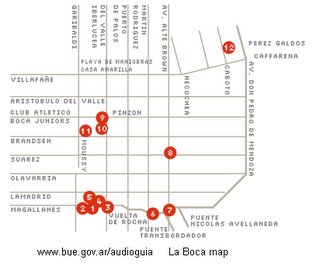
Description of La Boca circuits stops;

1 - La Boca neighborhood. A neighborhood unique in its architecture and its culture. Historians explain the origins of an area filled with immigrants, tenement houses and football. Duration: 2 min

2 - Quinquela Martin, his house…his life. The great artist Benito Quinquela Martin was one of the most relevant personalities of La Boca. Abandoned by his birth mother in an orphanage of the area, he describes his childhood in the neighborhood. Duration: 2 min

3 - Vuelta de Rocha In its beginnings, La Boca was a city slum, filled with shanties and “pulperias” (general stores). The port activity gave it a definite identity. This is how an old neighbor describes it. The tango “La Vuelta De Rocha” can be listened to as well. Duration: 1 min

4 - Caminito One of the most defining symbols of Buenos Aires hides behind the sheet metal and colorful houses of this little street of La Boca. To listen to: “Caminito”, and what Quinquela Martin thought of this tango piece, which found its inspiration in this place. Duration: 1 min

5 - Juan de Dios Filiberto, tango in La Boca. Juan de Dios Filiberto, who wrote the music for “Caminito”, is a synonym of tango in La Boca. Filiberto gives his opinion on the lyrics of his tango pieces. Duration: 1 min

6 - Museum of Fine Arts (Museo de Bellas Artes) Benito Quinquela Martin donated this building to the neighborhood that most inspired his art. The artist himself tells us the purpose of this museum and Perez Celis describes Quinquela as an artist. Duration: 1 min

7 - The Bridge of La Boca, a postcard scene. One of the outstanding symbols of the neighborhood of La Boca is this majestic iron bridge constructed over the Riachuelo. Quinquela Martin chose it as scenery for many of his paintings. Duration: 1 min

8 - The Republic of La Boca Throughout history, there were three attempts to found the Republic of La Boca. This is what Hugo Banchero, grandson of one of the founders, and historian Jose Gobello, tell us. Duration: 2 min

9 - Boca Juniors Sports Club. The history of one of the most important football teams in Argentina. Listen to Maradona talking about Boca Stadium and artist Perez Celis describing why he did the murals at the Club. Duration: 2 min

10 - Player number 12 The sound of the voice of the fans is felt at Boca Stadium like in no other stadium. This passion for football inspired films like “El hincha” (The Fan), with Enrique Santos Discepolo. A fragment of this movie and the voice of Diego Maradona talking to the Boca fans. Duration: 2 min

11 - Maradona, the story of an outstanding figure. The biography of one of the most famous football players in the world. To listen to: The most memorable goal of Maradona in the 1986 World Cup broadcast by Victor Hugo Morales, and National Team player number 10 telling us himself what glory means to him. Duration: 3 min

12 - Catalinas warehouse, “murga” culture. By means of theater, a group of people from La Boca recover the history of the neighborhood. A fragment of the show El Fulgor Argentino and an interview with its director, Adhemar Bianchi. Duration: 2 min

Turismo en formato Mp3

En Buenos Aires ya no hace falta un guía para recorrer sitios históricos y turísticos. El gobierno porteño en su sitio web http://www.bue.gov.ar/audioguia lanzó unas guías locutadas por famosos que hablan y cuentan la historia de las calles y edificios de la capital Argentina. La novedad surge que están en formato MP3 y se pueden bajar a cualquier reproductor para ser escuchadas en el recorrido por la ciudad. Hay 12 recorridos disponibles. Plaza de Mayo (por Mario Pergolini), Palermo Viejo (por Magdalena Ruíz Guiñazú) , Puerto Madero (por Nacha Guevara), Abasto (por Antonio Carrizo), La Boca (por Eduardo de la Puente). Cada recorrido posee un mapa para ser impreso.

Descripción de los recorridos en La Boca;

1 - Barrio de La Boca Un barrio único en su arquitectura y en su cultura. Historiadores explican cómo fue el origen de esta zona de fútbol, conventillos e inmigrantes. Duración: 1 min

2 - Quinquela Martín, su casa… su vida El magnífico pintor Benito Quinquela Martín fue una de las figuras más relevantes de La Boca. Abandonado por su madre natural en un orfanato de la zona, él mismo cuenta cómo fue su infancia en el barrio. Duración: 2 min

3 - Vuelta de Rocha En sus comienzos, La Boca era apenas un arrabal poblado por ranchos y pulperías. Fue la actividad portuaria lo que le dio una identidad definida. Así lo describe un viejo vecino del barrio. Además el tango “La Vuelta de Rocha” para escuchar. Duración: 1 min

4 - Caminito Uno de los mayores símbolos de Buenos Aires se esconde entre las chapas coloridas de las casas de esta callecita de La Boca. Para escuchar: “Caminito” y lo que pensaba Quinquela del tango inspirado en este lugar. Duración: 1 min

5 - Juan de Dios Filiberto, tango en La Boca Juan De Dios Filiberto —autor de la música de “Caminito”— es sinónimo de tango en La Boca. Filiberto opina de las letras de sus tangos. Duración: 1 min

6 - Museo de Bellas Artes Benito Quinquela Martín donó este edificio al barrio que le sirvió como fuente de inspiración. Él mismo cuenta cuál era su objetivo con este museo y Pérez Celis describe a Quinquela como artista. Duración: 1 min

7 - El puente de La Boca, una postal Uno de los mayores símbolos del barrio de La Boca es este imponente puente de hierro que se alza sobre el Riachuelo. Quinquela Martín lo eligió como escenario de muchas de sus pinturas. Duración: 1 min

8 - La República de La Boca A lo largo de la historia tres veces intentaron fundar La República de La Boca. Así lo cuentan Hugo Banchero, nieto de uno de los fundadores, y el historiador José Gobello. Duración: 2 min

9 - Club Atlético Boca Juniors La historia de uno de los clubes de fútbol más importante de la Argentina. Escuchá a Maradona hablando del estadio de Boca y el artista Pérez Celis contando porqué realizó los murales del club. Duración: 2 min

10 - El jugador número 12 La voz de los fanáticos se siente en el estadio de La Boca como en ningún otro. La pasión por el fútbol inspiró películas como El hincha, con Enrique Santos Discépolo. Un fragmento de la película y la voz de Diego Maradona hablándole a la hinchada de Boca. Duración: 2 min

11 - Maradona, la historia de un grande La biografía de uno de los jugadores de fútbol más famosos del mundo. Para escuchar: el gol más recordado de Maradona en el mundial de 1986 relatado por Víctor Hugo Morales y el mismo número 10 de la selección cuenta qué es para él la gloria. Duración: 3 min

12 - El Galpón de Catalinas, la cultura de la murga Por medio del teatro, el grupo de vecinos de La Boca recupera la memoria del barrio. Un fragmento del espectáculo El fulgor argentino y una entrevista a su director, Adhemar Bianchi. Duración: 2 min

Friday, June 02, 2006

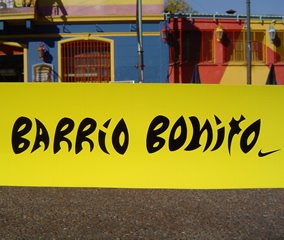
"Barrio Bonito" The Pretty District will be able to be visited / "Barrio Bonito" puede empezar a visitarse.

"Barrio Bonito" The Pretty District will be able to be visited. An idea developed by BBDO for Nike Argentina that was chosen by Nike International like one of the three more important global initiatives for the campaign Glass of World 2006. In occasion of the arrival of World-Wide Germany 2006 soccer championship, some artistics pieces took part the district “Barrio de la Boca” in Buenos Aires with thematic soccer like main by Nike and BBDO Ad agency. The objective is generate a legacy and an authentic contribution to the life of the place. In “Barrio Bonito” the spirit of the soccer of district and the art conjugate themselves, with the Nike contribution in terms of the “Joga Bonito” world campaign that world-wide is associated to the pretty game. “We are in the Third Era of the advertisement, thus we understand it in the agency with each project that we faced: the technology, the entertainment, the interactive participation of the person, is defining a different scene completely. The real experience for the people is to make the district “Barrio Bonito” within a district. This district came real because of the joy and the commitment of the inhabitants of “La Boca”. The initiative exceeds the symbolic benefit of the brand and take it to the point that the Government of the City sees it like tourist value. BBDO work in equipment with a client with a capacity of unusual vision. All this fills to us of much pride”, indicated Carlos Perez, President of BBDO Argentina. “We were with a global campaign that it very hard has a concept in soccer, “Joga Bonito”, but that in our country generates emotions quite polarizing because its associated with the “Brazil soccer”. The challenge went to transfer it to our streets, being generated actions with much local relevance. An idea that does not come in brief became real to make “Barrio Bonito”. An idea that required long working time with Nike as well as with the authorities of the City and the involved artists. “Barrio Bonito” is neither a commercial one, nor a graph, nor nothing similar. We worked with a new concept: the Artvertising”, indicated Nicolas Pimentel, Accounts Director of BBDO Argentina. Throughout the Garibaldi street between the streets Lamadrid and Quinquela, to meters of “Caminito”, BBDO and Nike implemented a series of actions between which they stand out: First interactive monument: an invitation to became real the best goal of the history of the world-wide ones: the goal of Maradona to the England in México world wide Championship in 1986 with its six players represented in statues. The monument is completed with one making the route of Diego Maradona. Tevez x Gasparini: The most iconic artist of the district of “La Boca”, Omar Gasparini, author of the sculptures to Maradona, Evita and Gardel, portrayed this time to Carlos Tevez, hero of the district and the soccer team “Boca Juniors”. Art with the Feet: Artists pertaining to the Association of Artists with the Mouth and the Foot, Antonella Semaán and the Spanish Manuel Parreño, reflected the magic of soccer. Their works of Carlos Tevez and Ronaldinho, also two artists of the feet, are exposed on murals in the Garibaldi street. Murals: The linen cloth is the wall, the brush the ball. This piece was called “Pelotazos”, Tevez, Agüero and Ronaldinho left to printings their pictures on murals in a new test of which they are able to do with the feet. Photographic exhibition: Urko Suaya, Alexander Burset, Marks Lopez, Ricardo Alfieri, Martin Sigal and Fabian Laghi portrayed their personal conception of each one of the five values of the game for Nike: it drags, ability, joy, honor and equipment. “Barrio bonito” has been considered of high tourist value by the organizations of “La Boca” and the Government of the City. From Monday the tour guides will include the” barrio Bonito”in their routes like attractive an additional one of the neighboorhood.

"Barrio Bonito" puede empezar a visitarse. A partir de hoy se podrá visitar el Barrio Bonito, una idea desarrollada por BBDO para

Nike Argentina que fue elegida por Nike Internacional como una de las tres iniciativas globales más importantes para la campaña Copa del Mundo 2006. Con motivo de la llegada del Mundial Alemania 2006, Nike y BBDO intervinieron artísticamente el barrio de "La Boca" con el fútbol como temática principal, con el objetivo de generar un legado y un aporte auténtico a la vida del lugar. En "Barrio Bonito" se conjugan el espíritu del fútbol de barrio y el arte, de la mano de una marca que mundialmente se asocia al juego bonito. "Estamos en la Tercera Era de la publicidad. Así lo entendemos en la agencia con cada proyecto que encaramos: la tecnología, el entretenimiento, la híperparticipación de la persona, están definiendo un escenario completamente diferente. Hacer un Barrio dentro de un barrio; hacerlo con la gente del lugar; ver la alegría y el compromiso de los habitantes de La Boca; convertir la iniciativa en algo que excede el beneficio simbólico para una marca y llevarlo al punto de que el Gobierno de la Ciudad lo vea como valor turístico; trabajar realmente en equipo con un cliente con una capacidad de visión y coraje inusuales, todo esto nos llena de mucho orgullo", señaló Carlos Pérez, Presidente de BBDO Argentina. "Nos encontramos con una campaña global que tiene un concepto muy fuerte en el fútbol, Jogo Bonito, pero que en nuestro país genera emociones bastante polarizantes. El desafío fue trasladarlo a nuestras calles, generando acciones con mucha relevancia local. Y así surgió la idea del Barrio. Una idea que no viene en un brief. Una idea que requirió mucho tiempo de trabajo con Nike así como con las autoridades de la Ciudad y los artistas involucrados. Barrio Bonito no es ni un comercial, ni una gráfica, ni nada parecido. Trabajamos con un nuevo concepto: el Artvertising", señaló Nicolás Pimentel, Director de Cuentas de BBDO Argentina. A lo largo de la calle Garibaldi entre las calles Lamadrid y Quinquela, a metros de Caminito, BBDO y Nike implementaron una serie de acciones entre las que se destacan: Primer monumento interactivo: una invitación a revivir el mejor gol de la historia de los mundiales: el gol de Maradona a los ingleses con sus seis jugadores representados en estatuas. El monumento se completa con uno realizando el recorrido de Diego. Tevez x Gasparini: El artista más icónico del barrio de La Boca, Omar Gasparini, autor de las esculturas a Maradona, Evita y Gardel, retrató esta vez a Carlos Tevez, ídolo del barrio. Arte con los Pies: Artistas pertenecientes a la Asociación de Artistas con la Boca y el Pie, Antonella Semaán y el español Manuel Parreño, reflejaron la magia del fútbol. Sus obras de Carlos Tevez y Ronaldinho, también dos artistas de los pies, están expuestas sobre murales en la calle Garibaldi. Murales: El lienzo es la pared, el pincel la pelota. Mediante pelotazos, Tevez, Agüero y Ronaldinho dejaron estampados sus retratos sobre murales en una nueva demostración de lo que son capaces de hacer con los pies. Exposición fotográfica: Urko Suaya, Alejandro Burset, Marcos López, Ricardo Alfieri, Martin Sigal y Fabián Laghi retrataron su concepción personal de cada uno de los cinco valores del juego para Nike: garra, habilidad, alegría, honor y equipo. El Barrio Bonito ha sido considerado de alto valor turístico por las organizaciones de La Boca y el Gobierno de la Ciudad. Desde el lunes las guías turísticas incluirán al Barrio Bonito en sus recorridos como un atractivo adicional de la zona.

Friday, May 26, 2006

A Snapshot on fairs in Buenos Aires / Radiografía de las ferias de Buenos Aires

A Snapshot on fairs in Buenos Aires . Buenos Aires currently boasts fairs that have become true emblems of the city and imbue the neighboorhoods where ther are held with deepes identity. The fair held at Plaza Cortazar also known as Placita Serrano, stands out for its unconventional items, which are different from those offered by most fairs in other points of the city. This is a place where design, innovation, non-standard cloting and unconventional fabrics and models are dominant. In Recoleta, the never-ending Plaza Francia manages to make the already vibrant grass-carpeted scenery even more colorful with its array of arts and crafts stands.

San Telmo, boasts its antiques fair, where the most unthinkable items can be found as if they were floating amid the neighboorhood's typical inmigrant quarter atmosphere. The area retained its colonial architecture: standing among these constructions, the fair on Plaza Dorrego is like a huge shop window that displays extremely ancient lamps as well as jewelry, period clothes, books and other objects that can make us travel through time just by catching our eye.As a result of the large number of visitors that this fair receives every weekend, stands have spread out to neighboring streets, adding more crafts novelties. The atmosphere of this spot is enriched by tango dancers, musicians and human statues that pass the hat around after their perfomances. The nearby streets afford a combination of cafés, restaurants, and prestigious antique stores.The San Pedro Telmo fair is one of the major sights around town and has become increasingly advertised over the past few years. With the characteristic odor - which is reminiscent of things retrieved from old chests - , its cobbled streets, its well-preserved architectural heritage and its bohemian air, this fair fascinated tourists and is a source of pride for Buenos Aires locals.

Radiografía de las ferias de Buenos Aires.

Hoy en Buenos Aires existen ferias que se han transformado en emblemas de la ciudad y que le aportan identidad al barrio que las acoge.

La de Plaza Cortazár, la placita Serrano, se destaca por sus artículos no convencionales, distintos a los que ofrecen la mayoría de ferias de diferentes puntos de la ciudad. Aquí impera el diseño, las novedades, la ropa no estandarizada, las telas y modelos menos convencionales. En Recoleta, la interminable feria de Plaza Francia aporta aún más colorido, con sus puestos de artesanos, al pasto que alfombra este espacio abierto.

Mientras que San Telmo tiene sus ferias de antiguedades en donde los más impensados objetos añejos se pueden encontar flotando en ese aire de arrabal. El barrio conserva su arquitectura colonial y en medio de dichas construcciones la feria, ubicada en la Plaza Dorrego, es una inmensa vidriera que reúne antiquísimas lámparas, joyas, vestidos de época, libros y demas objetos que con solo contemplarlos nos traslada en el tiempo. Por la cantidad de visitantes que recibe la feria cada fin de semana se han extendido los puestos a pasajes aledaños que agregar artesanías y novedades. La atmosfera de este paseo se completa con los bailarines de tango, músicos y estatuas vivientes que brindan espéctaculos " a la gorra". Las veredas de alrededor alternan cafés, restaurantes y anticuarios prestigiosos. La Feria de San Pedro Telmo es uno de los atractivos turísticos de la ciudad. Con su olor característico de objetos rescatados de viejos baúles, sus calles empedradas, su patrimonio arqutectónico bien conservado y su aire bohemio, fascina al turista y enorgullece al porteño.

Links www.feriasdedisenio.com.ar www.santelmo1.com www.bue.gov.ar/audioguia www.feriadeanticuarios.org

Wednesday, April 19, 2006

Buenos Aires Misteriosa

Buenos Aires Misteriosa. -A new kind of excursion has been born in Buenos Aires: telling crime stories and mysterious legends to the visitor. Buenos Aires city doesn’t have the characteristic of beautiful sceneries: there aren’t lakes, mountains or seaside, but it is a place where million of stories and legends took place, some of them true… but others we're not too sure. Considering this, a new kind of tourism has been born – far from the traditional centers of attraction – that tells the visitor, even the “porteños”, the hidden mysteries of this metropolis. People have started to look for this activity more often, because they believed that they knew Buenos Aires, but they realized that it wasn’t completely true. Some foreigners do it, but most of the visitors are from Argentina, from the provinces (people who've already been to the city and don't need to visit the Obelisco!). Visiting the cemeteries is an option that this new trend offers. They show, for example, the place that a mother created to sleep beside her daughter’s grave, or the room that they built to a bride who died on her honeymoon. All stories full of morbidity, craziness and death that manage to frighten everyone, even the most skeptical tourist. "Buenos Aires Misteriosa" ("Mysterious Buenos Aires") is an excursion that consists on a night circuit by bus, with narrations of crimes and urban fables. The best of it is that you can perfectly imagine the scene, because during the trip they show you the house, for example, where “Yiya Murano” (a well known story in Buenos Aires of a woman who poisoned people) poisoned one of her friends; or the wasteland where the legendary “Petiso Orejudo” (“Short and big-eared”) killed one of his victims. The darkness of the bus, the horror music and the excellent voice of a announcer help to reach the proper climate. The selection of the stories was a hard job of investigation from books, newspapers, magazines and proposals of the people about the mysterious Buenos Aires. The circuit lasts about two hour to fit in the stories of murders and legends that happened each specific area including the San Cristóbal, Barracas, Parque Patricios and San Telmo neighborhoods. This conditioned a lot, because they need to tell stories of murders and legends that happened each specific area. As it is difficult to do both the south and the north of the city on a single trip, they will launch Mystery Buenos Aires II soon, visiting other porteños neighborhoods, Check http://www.horizontesviajes.com.ar/.
Buenos Aires Misteriosa
- Una nueva modalidad de excursiones surgió en Buenos Aires: contarle al visitante historias de crímenes y misteriosas leyendas durante el recorrido. La Ciudad de Buenos Aires no se caracteriza por tener bellos paisajes: no hay lagos, montañas, ni mar, pero fue el lugar en el que se desarrollaron millones de historias y leyendas, algunas verdaderas y otras no tanto. Teniendo en cuenta esto, surgió una nueva forma de turismo – alejada de los tradicionales centros de atracción – que tiene la particularidad de contarle al visitante, e inclusive al mismo porteño, los misterios ocultos de esta metrópoli. La gente comenzó a buscar estas salidas cada vez más porque creen conocer Buenos Aires, pero en realidad no es así. Algunos extranjeros las hacen, pero la mayoría son locales o gente del interior que ya vino a la ciudad alguna vez y, por lo tanto, no necesita ir a ver el Obelisco. Las visitas por los cementerios son una de las opciones que ofrece esta novedosa tendencia.. En ellas se puede ver el lugar que hizo una madre para dormir junto a la tumba de su hija o la habitación que le construyeron a una novia que murió en su luna de miel. Todas historias cargadas de morbosidad, locura y muerte que logran erizar la piel del más escéptico turista. Buenos Aires Misteriosa es una excursión que consiste en un circuito nocturno en ómnibus con narraciones de crímenes y fábulas urbanas. Lo mejor es que uno puede imaginarse la escena a la perfección, ya que durante el trayecto le señalan la casa en la que, por ejemplo, Yiya Murano ( conocida historia en Buenos Aires sobre una mujer que envenenaba) envenenó a una de sus amigas o el baldío – antes conventillo - donde el legendario Petiso Orejudo ( personaje legendario en Buenos Aires ) mató a algunas de sus víctimas. La oscuridad del micro, la música de terror y la voz de una excelente relatora ayudan a alcanzar el clima adecuado. La selección de historias fue un largo y duro trabajo de investigación acerca de la Misteriosa Buenos Aires. Se realizó a partir de libros, diarios, revistas y sugerencias de la gente. El circuito, que dura poco más de dos horas, recorre los barrios de San Cristóbal, Barracas, Parque Patricios y San Telmo. Esto condiciona bastante, ya que se deben elegir asesinatos y leyendas que sucedieron dentro de la misma zona. No se puede ir del sur al norte de la ciudad en una misma salida. Por esta razón, pronto se lanzará Buenos Aires Misteriosa II, en la cual se recorrerán otros barrios porteños.
Chequear http://www.horizontesviajes.com.ar/
Google